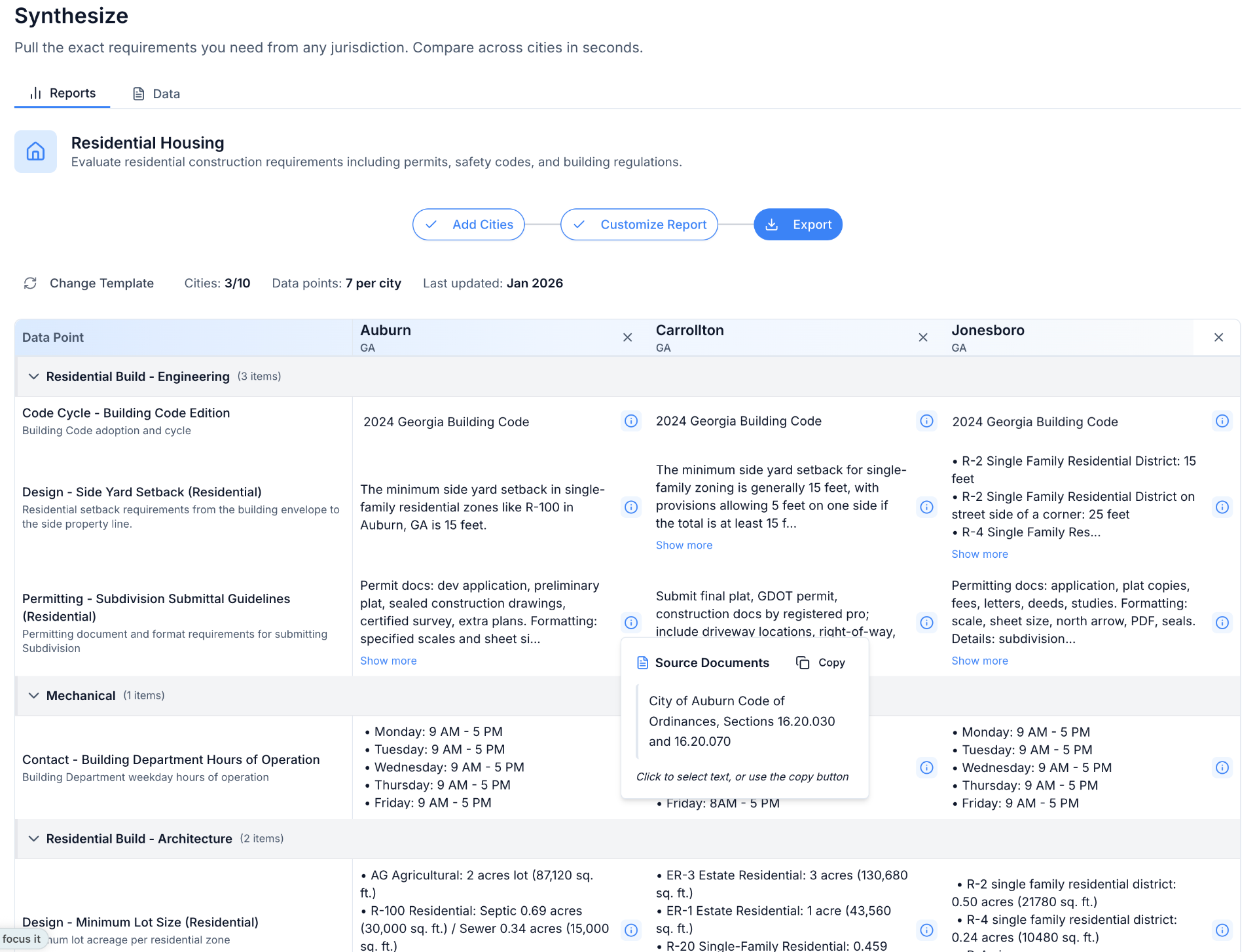


Every VP of Operations has felt it - schedules slipping, permits bouncing, crews sitting idle while the cause hides behind generic phrases like "permitting delays" or "project complexity."
It's not labor. It's not materials. It's the hidden variable in every construction timeline: local code confusion.
Across the U.S., fragmented and frequently changing building codes drain an estimated $121 billion from the construction industry every year. It's the largest untracked operational cost, and one that compounds silently across portfolios.
The Real Cost of Code Complexity
We've spent the last 15 years in the field, working in Operations for national solar installers, wrestling with this problem: local code requirements that are fragmented, changing, and nearly impossible to track at scale.
Joint research from the National Association of Home Builders (NAHB) and National Multifamily Housing Council (NMHC) shows that changes to building codes now account for 11.1% of total development costs. The single largest regulatory driver in the industry.
When applied to the sectors most exposed to local variance, the math is straightforward:
- Residential: $895B in annual spending × 11.1% = $99.4B
- Commercial: $199.5B × 11.1% = $22.1B
- Total: Over $121B annually lost to code-driven inefficiency
Total: Over $121B annually lost to code-driven inefficiency. And this number grows as we expand across more construction verticals - clean tech deployment, industrial facilities, mixed-use development - anywhere local code complexity determines what can be built and how fast.
Where It Shows Up
Residential builders managing projects across 15+ states face 25-33% permit rejection rates, adding 12+ weeks per failed inspection. The playbook that works in Austin doesn't work in Dallas, and doesn't work in Houston. And all three updated their codes in the last 18 months.
Commercial developers discover mid-design that a local setback requirement nobody caught triggers rework across the entire engineering team's queue. Each missed update causes redesign and schedule slippage that ripples across dependent projects.
Clean tech operators deploying solar, HVAC, or EV infrastructure across 20+ states face 25–40% rejection rates adding 4-6 weeks per site. One in three sold projects in residential solar gets canceled due to delays. An operational failure driven by code complexity.
Why No One Talks About It
Code confusion doesn't make headlines. It's diffuse, showing up as:
- The three weeks your architect spent researching fire code requirements for a new market
- The permit rejected because a local requirement nobody caught triggers engineering rework
- The Phoenix expansion that took nine months instead of three learning Maricopa County's overlay requirements
- The project pro forma that doesn't work because timeline delays changed your interest rate environment
When the board asks why the quarter missed projections, "code confusion" doesn't show up as a line item. It gets absorbed into "permitting delays" or "project complexity."
So teams maintain Excel spreadsheets that go stale when city councils update ordinances. Call building departments to clarify conflicting rules. Submit permits over and over until they get it right. Build internal playbooks that take six months per new market.
The cost is massive, but invisible. And invisible problems don't get solved—they get absorbed.
Why It's Getting Worse
Codes are evolving faster. Cities update requirements more frequently for housing shortages, climate goals, and safety concerns. Energy efficiency standards, fire access rules, EV charging mandates—what was true 18 months ago isn't true today. Example: California and Nevada will be adopting new codes and amendments on Jan 1st, 2026.
Everyone's expanding simultaneously. The U.S. needs 5 million more housing units. Clean tech deployment accelerates regardless of federal policy, driven by utility mandates and corporate ESG commitments. Energy demand surges with AI infrastructure and data centers requiring massive power support. Firms that operated in 5 markets now scale to 20.
The complexity is structural. With 30,000+ jurisdictions, the path from local ordinance to actual requirements is incredibly difficult to follow. Rules do line up, but they're just layered across multiple code books with complex precedence hierarchies. Counties add requirements on top of cities. States set minimums that locals exceed. Things accidentally conflict. About two-thirds of cities reference state-adopted codes from different years or books: 2020 NEC in one state, 2018 in another, mixed with different vintages of IBC, IRC, IECC.
Tracing what actually applies requires following threads across multiple sources, understanding which takes priority when they conflict, and catching gaps where requirements aren't explicitly stated but implied by reference. Trying to solve this with phone calls and PDFs doesn't scale.
The Operational Impact
When code complexity goes unmanaged:
- Geographic expansion stalls. Every new market means months researching which version of which code books the city adopted, how county requirements overlay, what state mandates supersede local rules. You can't build scalable playbooks or forecast timelines reliably.
- Revenue becomes unpredictable. When 25-33% of permits get rejected, you can't forecast project completion dates or revenue. Carrying costs on stalled projects eat margins. Crews sit idle or get pulled to other jobs, destroying efficiency.
- Competitive advantage erodes. Firms that navigate code complexity faster win more deals, expand into more markets, and deliver projects on time. The ones that can't get stuck watching competitors scale past them.
- Trust disappears. Investors lose confidence when timelines slip. Buyers walk when projects delay. Partners question whether your team can deliver. Code-driven delays create downstream damage that's hard to quantify but impossible to ignore.
The Quiet Part
Here's what everyone knows but rarely says:
The problem is solvable. This isn't an inherent limitation of construction. It's a data and intelligence problem. The requirements exist - they're locked in thousands of PDFs and ordinances that don't talk to each other. The logic exists - someone just needs to structure it to reflect how codes actually layer across jurisdictions.
Excel isn't infrastructure. Maintaining spreadsheets of code requirements is reactive strategy that breaks at scale. It's damage control, not prevention.
Operators are ready for a better way. Every conversation with VPs of Operations ends the same: "We've been waiting for someone to solve this."
What This Means
The $121 billion represents millions of hours of wasted research, thousands of projects delayed, hundreds of markets out of reach, and countless operators who know their teams could move faster with clarity on code requirements before problems become expensive.
Code confusion is the invisible bottleneck slowing everything down. The firms that solve it first will scale fastest, win more deals, and capture the markets everyone else is still figuring out.
Ready to stop losing time and money to code confusion?
We've built something for operators tired of flying blind into new markets and watching projects stall on preventable code issues. If you're expanding across markets and code complexity is slowing you down, let's talk.