
Austin, Pflugerville, and Manor, Texas sit within 20 miles of each other in Travis County. Same market. Same labor pool. Same material suppliers.
But a residential builder operating in all three is effectively managing three different construction standards, three different material requirements, and three different timelines—all in the same backyard.
This is home rule. And while Texas is booming, accounting for 15% of all residential building permits in 2025 despite having only 9% of the U.S. population, home rule makes capturing that growth exponentially harder than it should be. The market pressure is there. The code complexity is the bottleneck.
What Home Rule Actually Means
City codes govern everything from where buildings can be located (zoning) to what they're made of (building codes) to how they're equipped for safety (fire codes). They're complex by necessity - constantly evolving to enhance safety, respond to environmental changes, and meet community priorities.
Codes are set at multiple levels: international model codes (like the ICC family), state requirements, county standards, and city ordinances. Each layer refines and adapts standards to address local needs. Cities typically make codes more strict than higher-level standards, adding requirements for local climate conditions, density concerns, or safety priorities. Codes reflect what communities value: strict energy standards might reduce long-term homeowner costs, while less restrictive codes might remove barriers to housing production.
In most states, cities start with a state-mandated baseline and add local amendments on top. But in home rule states, cities have complete autonomy. About a third of U.S. cities operate under home rule, giving them broad authority to set their own standards.
Texas is a home rule state. This means:
- There are no state-mandated building codes (though the state provides code books cities can reference if they choose)
- Cities independently choose which model codes to reference, if any
- Each city decides which versions to adopt (2024 IRC, 2021 IRC, 2015 IRC, or none)
- Cities can even adopt code standards from other states if they prefer them
Essentially, each of Texas's 1,200+ jurisdictions looks at available code books, decides what "best practices" align with their priorities, and adopts accordingly. Some cities stay current with the latest International Code Council (ICC) standards. Others adopt codes that are years or even decades old. Some adopt minimal requirements to encourage faster housing production. Others adopt strict standards to maximize safety or energy efficiency.
There's no baseline. No standardization. No requirement to follow any particular code family or version.
The result: geographic proximity means nothing when it comes to code requirements. Neighboring cities can operate in completely different regulatory worlds.
Three Cities, Three Code Worlds
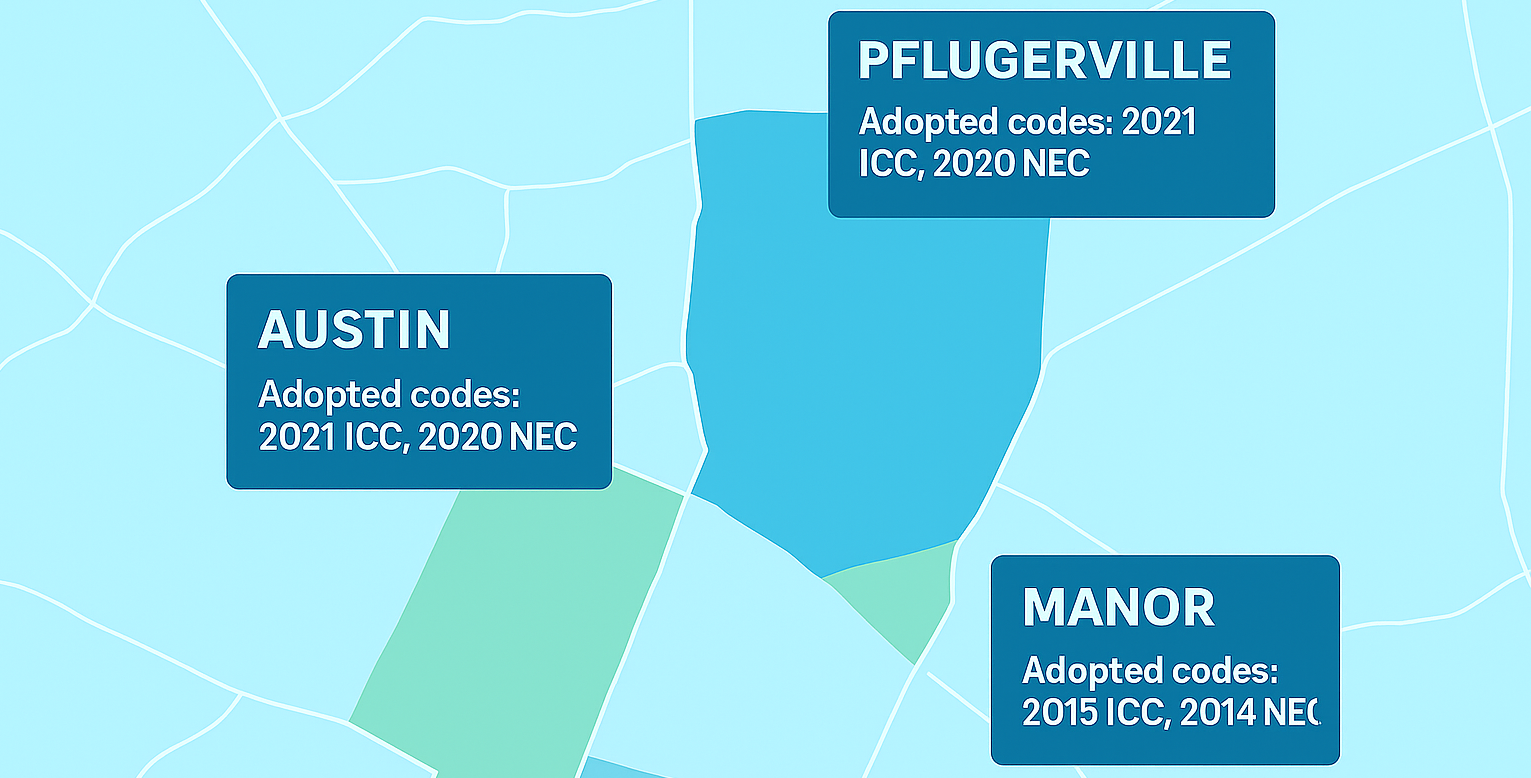
Let's look at Austin, Pflugerville, and Manor—three cities within Travis County, separated by less than 20 miles.
Austin
- Adopted codes: 2024 ICC, 2023 NEC
- Notable: Updated April 2025, effective July 2025
- What's different: 2024 IRC incorporates optional provisions and resources promoting all-electric residential construction
Pflugerville
- Adopted codes: 2021 ICC, 2020 NEC
- Code lag: 3 years behind Austin
Manor
- Adopted codes: 2015 ICC, 2014 NEC
- Code lag: 9 years behind Austin
On a map, these cities nearly touch. But from a code perspective, they exist in different decades.
What This Means for Residential Builders
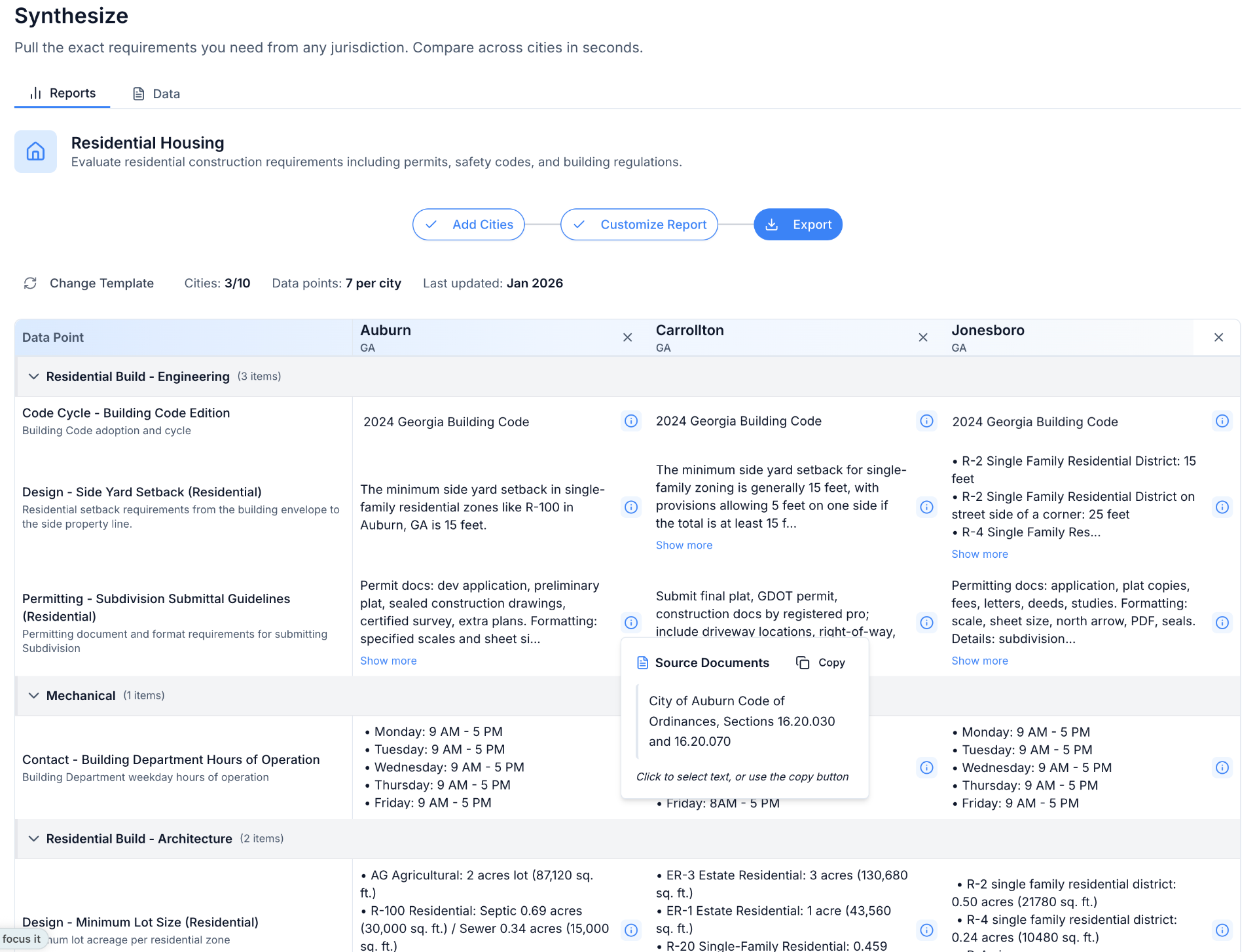
The differences aren't just academic. They translate directly into design requirements, material costs, labor needs, and project timelines. Here's what changed between the code versions these three cities adopted (based on analysis of IECC evolution, NEC 2020 changes, NEC 2023 updates, and 2024 IECC impacts):
Energy Efficiency and Envelope Requirements
Manor (2015 ICC): Baseline older standards with fewer mandatory efficiency requirements, lower insulation minimums, and simpler HVAC and ventilation rules.
Pflugerville (2021 ICC): Raised envelope, insulation, and fenestration minimums. Mandatory additional efficiency options. Tighter HVAC and ventilation requirements.
Austin (2024 ICC): Further efficiency push with more flexible compliance paths, new air-leakage standards, updated structural and load tables. Homes must be designed to accommodate future solar installation, meaning:
- Lot layouts optimized for south-facing roof exposure
- Architectural planning that accounts for solar accessibility
- Reduced flexibility in subdivision design
- Battery storage preparation requiring infrastructure planning from day one
Impact: Builders must scale up envelope and HVAC design as they move between jurisdictions. What's acceptable in Manor won't pass in Austin. Design teams can't reuse specifications across cities.
Electrical Requirements (NEC)
Manor (2014 NEC): Fewer requirements around PV, energy storage systems (ESS), and EV charging. Basic GFCI and AFCI protection with less specificity.
Pflugerville (2020 NEC): Major jump for renewables and energy storage. Introduction of Article 706 for ESS, refined PV rapid-shutdown requirements, improved interconnection rules. More documentation required for pre-permit packages.
Austin (2023 NEC): Expanded GFCI/AFCI requirements for kitchens and other spaces. New surge protection and barrier requirements. More specific branch-circuit recognition standards.
Impact: An electrician trained on Manor's 2014 NEC standards needs significant retraining for Austin's 2023 requirements. Material specifications differ. Installations that comply in Manor may not meet Austin's standards, even for the same solar or HVAC system.
Fire Safety Requirements
Austin's 2024 code adoption brings fire safety requirements that didn't exist in previous cycles, including enhanced fire-resistant gypsum in specific applications and expanded sprinkler system requirements. These materials face sourcing delays and require more specialized labor. A crew efficient in Manor using 2015 standards needs different training, different materials, and more time to complete the same square footage in Austin.
Permitting and Documentation
Documentation requirements increase with each code cycle. Manor's 2015 codes require simpler submittals. Pflugerville's 2021 codes add energy-compliance reports, ESS equipment documentation, and PV labeling. Austin's 2024 codes further increase the burden with new structural and energy compliance paths, updated electrical safety requirements, and new formatting standards. More requirements mean more inspection cycles - Austin projects require additional touchpoints to verify solar-ready infrastructure, battery storage preparation, enhanced gypsum installation, and updated sprinkler systems. Each additional inspection adds time and creates opportunities for delays.
Builders and clean-tech integrators face the same challenge: installations under 2014 NEC may not comply when an AHJ adopts 2023. Home builders must verify homes meet solar-ready design standards in Austin, but work with 2015 standards in Manor that predate modern clean tech considerations. An HVAC contractor quoting projects can't assume what worked in Manor will work in Austin - the infrastructure, inspection process, and even ventilation requirements may be fundamentally different.
The Operational Nightmare
Here's what this looks like in practice:
You can't reuse plans. A home design approved in Manor won't meet Austin's solar-ready requirements. Plans need to be modified—or rebuilt—for each jurisdiction.
You can't standardize material orders. What's required in Austin (enhanced gypsum, specific sprinkler configurations) may be overkill in Manor. But under-ordering means project delays.
You can't train crews once. Land Planning or AEC Teams (Architecture, Engineering, and Construction) in Austin needs to understand solar-ready design constraints that don't exist in Pflugerville. Electricians need to know different NEC versions are in play.
You can't forecast timelines reliably. Austin's additional inspection cycles mean projects take longer. But if you build that buffer into your Manor projects, you're leaving money on the table.
A builder managing a handful of residential projects split across these three cities isn't running one operation. They're running three parallel operations with different standards, different costs, and different schedules. All within a 20-mile radius.
Why This Gets Worse Over Time
The divergence doesn't stay static. It accelerates.
Cities update at different rates. Austin adopted 2024 codes in April 2025. Pflugerville is still on 2021 codes. Manor hasn't updated since 2015. There's no coordinated timeline, no regional alignment, no predictability about when updates will happen.
New requirements compound complexity. When Austin adopted 2024 codes, it didn't just update existing requirements - it added entirely new categories (solar-ready design, battery storage prep). Each code cycle introduces new layers that older jurisdictions don't have.
Material and labor markets don't align. Suppliers and contractors serve all three cities, but the requirements are fragmented. A supplier stocking for Manor's 2015 standards may not have the enhanced gypsum Austin requires. A crew trained for Pflugerville's 2021 codes needs retraining for Austin's 2024 standards.
The gap between jurisdictions grows with every code cycle that one city updates and another doesn't.
The Home Rule Reality Across the U.S.
Texas isn't an outlier—about a third of the country operates under home rule. These states include some of the fastest-growing construction markets:
- Texas: 1,200+ jurisdictions
- Illinois: 1,400+ jurisdictions
- Ohio: 900+ jurisdictions
- Colorado: 300+ jurisdictions
In each of these states, every city operates independently. There's no baseline. No standardization. No way to assume that what works in one city will work in the next.
Contrast this with state adoption states like California or Florida, where state-level code adoption creates a foundation that all jurisdictions build on. You still have local amendments and variations, but you start with a common baseline. In home rule states, you start from zero in every city.
What This Means for Operators
If you're a residential builder, solar installer, or HVAC contractor expanding across markets in a home rule state, every new city is a research project:
- Which code versions has the city adopted?
- Are there local amendments that modify those codes?
- How do county-level requirements (if any) layer on top of city requirements?
- When was the last update, and when is the next one expected?
For a single city, this is manageable. For 10 cities, it's a burden. For 50+ cities across multiple home rule states, it becomes the bottleneck that limits how fast you can scale.
The operational tax isn't just time - it's the margin compression that comes from:
- Plans that need to be redrawn for each jurisdiction
- Material orders that can't be standardized
- Crews that need jurisdiction-specific training
- Timelines that vary by 20-30% based on inspection requirements
- Permit rejections and inspection failures (and resulting rework and delays) when your team misses a local requirement that didn't exist in the last city
The Path Forward
Home rule isn't going away. Cities value the autonomy to set standards that reflect local priorities. But the operational burden of navigating 30,000+ independent jurisdictions doesn't have to be a permanent cost of doing business.
The requirements exist. The logic exists. The challenge is structuring that information so it reflects how codes actually work (layered, jurisdictional, and constantly changing) and making it accessible when operators need it most: before plans are drawn, before materials are ordered, before permits are submitted.
For builders and installers operating across home rule states, the question isn't whether code complexity will slow you down. It's whether you'll have the intelligence to navigate it before it becomes expensive.
Expanding across Texas or other home rule states? Learn how operators are turning code complexity from a bottleneck into a competitive advantage. Request a demo to see how Fordje helps teams navigate 30,000+ jurisdictions with confidence.